Full-Scale A320 Cockpit Simulator
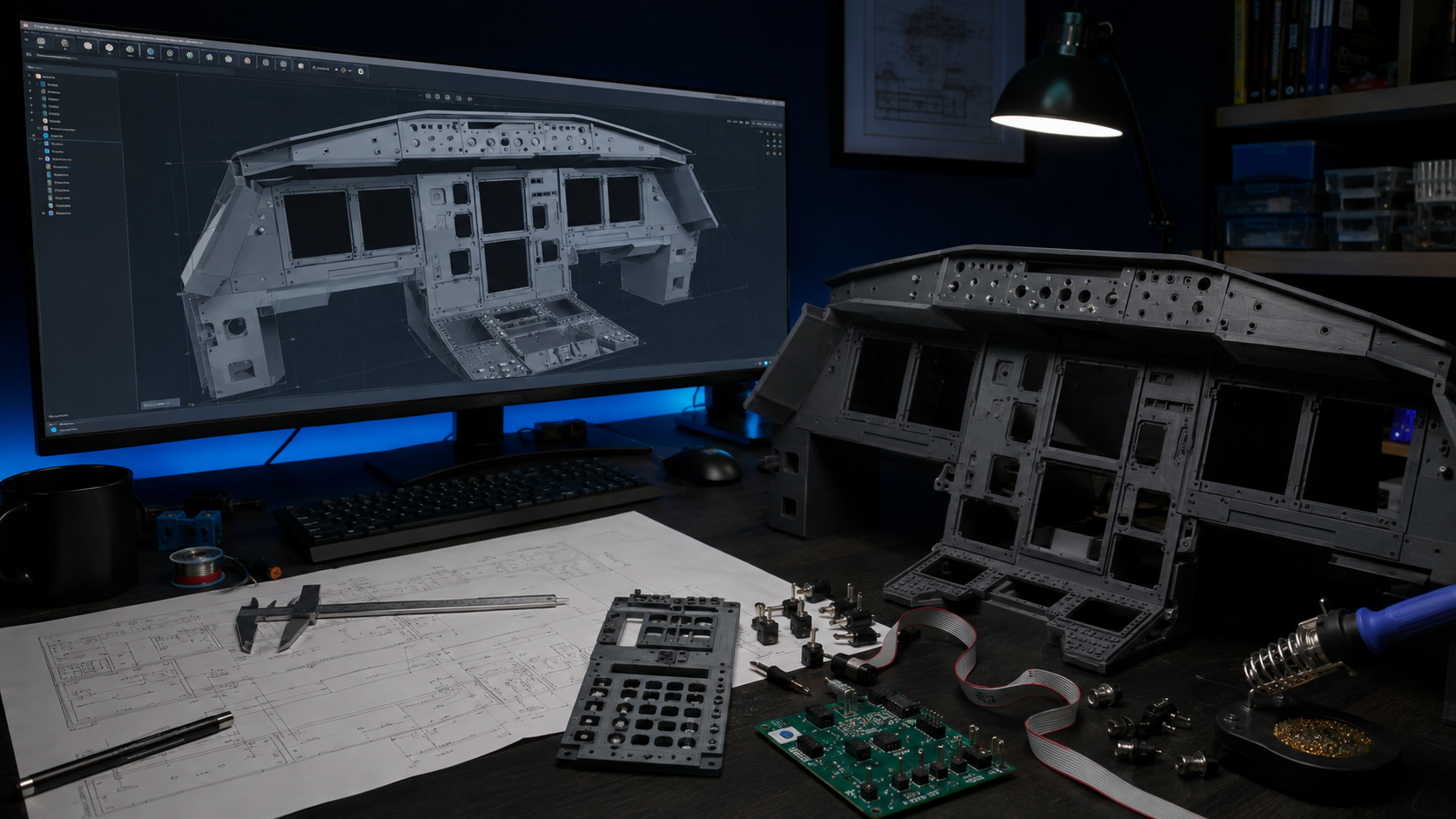
A planned 1:1 enclosed Airbus A320 cockpit simulator built from the ground up with custom electronics, panels, displays, and simulator integration.
Tech Stack
Overview
This project is my long-term plan to build a fully enclosed, full-scale Airbus A320 cockpit simulator inside an apartment.
The simulator will reproduce the cockpit at approximately a 1:1 scale, with particular attention given to the front instrument area. The eventual goal is to recreate the complete flight deck, including its physical controls, panels, displays, lighting, electronics, and simulator integration.
Instead of purchasing a completed simulator, I want to design and manufacture as many components as possible. The project is intended to provide hands-on engineering experience across software, electronics, mechanical design, fabrication, and system integration.
It is also the natural result of being a huge aviation enthusiast.
Why the Airbus A320?
The A320 is large enough to provide a realistic full-cockpit experience while remaining practical enough to fit inside an apartment.
A larger aircraft would make a 1:1 build substantially more difficult because of the additional physical space required.
The A320’s fly-by-wire design is another important reason for choosing it. Boeing-style control columns generally involve mechanically connected control systems that would be difficult to construct and synchronize accurately.
The A320 uses side-stick controllers without a mechanically connected shaft between the two controls, making it more practical for a largely custom-built simulator.
Planned Scope
The current vision is a complete enclosed cockpit, with the front cockpit receiving the greatest initial attention.
The project will eventually include:
- Full-scale cockpit structure
- Main instrument panel
- Primary and navigation displays
- Flight Control Unit and glare-shield controls
- Centre pedestal
- Throttle quadrant
- Multipurpose Control and Display Units
- Overhead panel
- Side-stick controls
- Rudder pedals
- Cockpit lighting
- Seats and interior details
- External visual displays
- Simulator computer and supporting electronics
The scope may evolve as individual systems are researched, designed, prototyped, and tested.
Display System
The current design is expected to use approximately nine HDMI display outputs.
These displays will reproduce the aircraft’s instruments, multifunction displays, control interfaces, and external visual environment.
Managing this number of displays will require careful planning around:
- Graphics hardware
- Display resolution
- Video-output distribution
- Cable management
- Power consumption
- Software configuration
- Physical mounting and alignment
Software Integration
The simulator is planned around Microsoft Flight Simulator, with ProSim and MobiFlight being considered for aircraft-system simulation and hardware communication.
These tools will connect physical switches, buttons, displays, indicators, and custom electronics to the simulated aircraft.
The final software architecture will depend on compatibility, reliability, cost, and how much functionality can be developed independently.
Building Instead of Buying
A major goal is to manufacture as much of the cockpit as possible while keeping the total cost under control.
Instead of relying entirely on commercial simulator panels, I plan to explore:
- Custom printed circuit boards
- 3D-printed components
- CAD-designed panels and enclosures
- Custom wiring harnesses
- Switch matrices
- Microcontroller-based input systems
- Locally fabricated structural components
- Modified or repurposed hardware
Commercial components will be used where manufacturing them would be impractical, unsafe, or significantly more expensive.
One-USB MCDU Subproject
One of the first major subprojects is a custom A320 Multipurpose Control and Display Unit keypad.
The goal is to connect the complete keypad using a single USB connection. This requires designing a button matrix, selecting suitable electronics, creating a custom PCB, and manufacturing the physical keypad and enclosure using 3D-printed components.
Although the MCDU is part of the larger cockpit, it is being developed as an independent module that can be designed, tested, and improved before integration.
This subproject will provide experience with:
- PCB design
- Matrix scanning
- USB input handling
- Embedded programming
- Switch selection
- 3D modelling and printing
- Panel assembly
- Simulator integration
Current Stage
The project is currently in the research and planning phase.
The present work focuses on understanding:
- Accurate cockpit dimensions
- Panel layouts
- Display requirements
- Suitable simulator software
- Electronics architecture
- Manufacturing methods
- Component availability
- Apartment space requirements
- Power and cooling requirements
- Total project cost
Careful planning is important because decisions made for one panel may affect wiring, structure, displays, software, and future components.
Budget and Timeline
The estimated budget for the complete build is approximately:
$10,000–$15,000 CAD
The expected development timeline is:
3–3.5 years
Both estimates may change as the design develops and individual components are tested.
Building parts independently, using 3D printing, designing custom PCBs, and repurposing suitable hardware should help reduce the cost compared with purchasing a commercial cockpit simulator.
Engineering Goals
This project brings together several engineering disciplines:
- Software development
- Embedded systems
- Electronics
- PCB design
- Human-interface design
- CAD and mechanical design
- 3D printing
- Structural fabrication
- Networking
- Power distribution
- System integration
The challenge is not only building individual panels. Every subsystem must eventually operate as part of one reliable and maintainable cockpit.
Long-Term Vision
The final goal is an immersive, enclosed A320 cockpit that feels like one complete aircraft system rather than a collection of unrelated simulator accessories.
Success will mean sitting inside a full-scale cockpit, completing a flight using physical controls and displays, and knowing that much of the system was personally designed, manufactured, programmed, wired, and integrated.