Private Home Server Infrastructure
A privacy-focused home server evolving into a centralized platform for storage, media, automation, networking, and locally hosted AI.
Tech Stack
Overview
This project is my attempt to build a private, household-scale computing infrastructure that can replace subscription-based cloud services and keep personal data under my control.
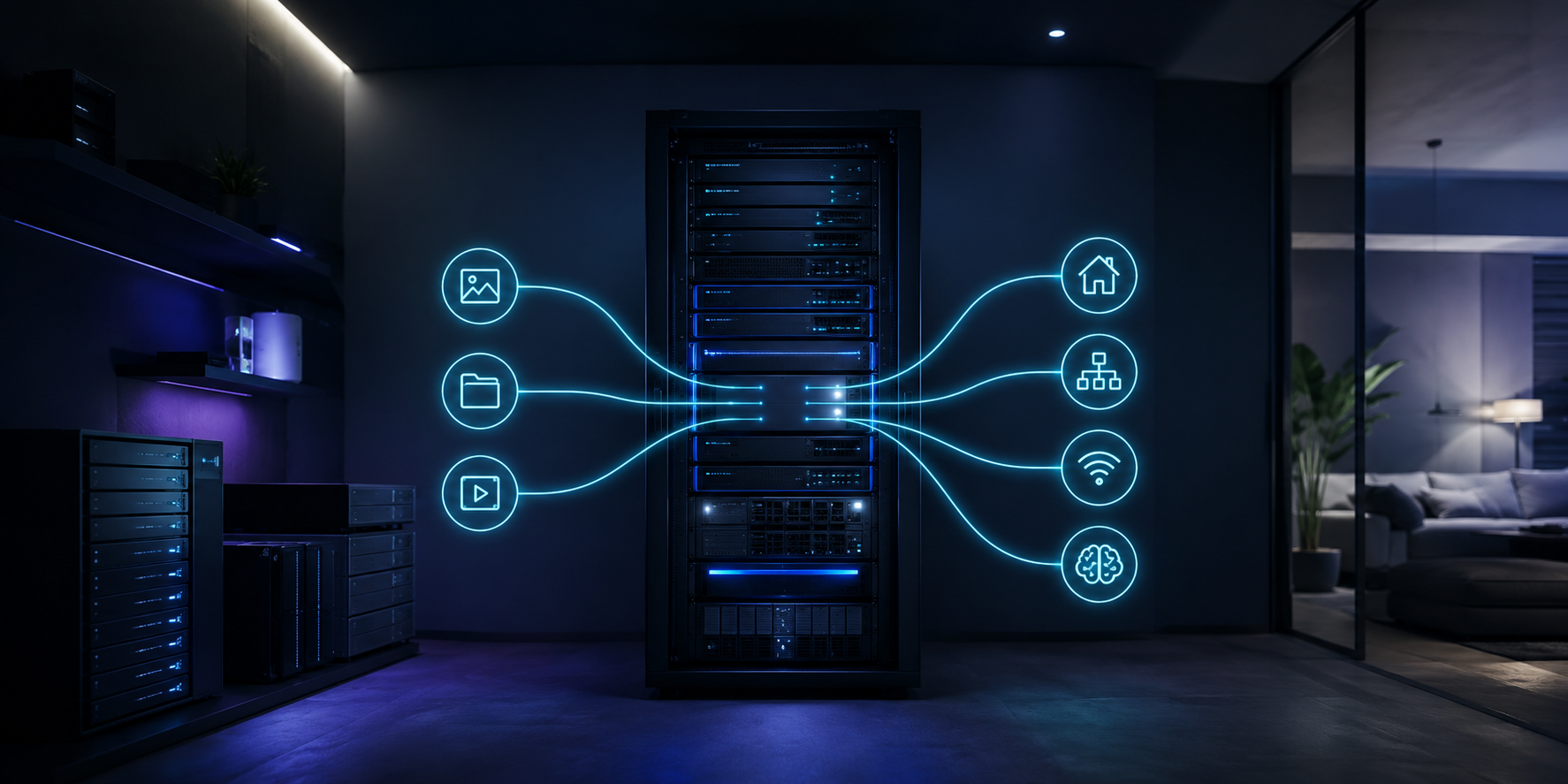
It began as a simple home server running Immich, but the long-term vision is much larger. I eventually want to build a dedicated server room that operates like a small private data centre—processing, storing, and managing data before distributing services throughout the home.
The system will eventually support private storage, photo management, media streaming, home automation, network management, security, and locally hosted AI models.
Why I Started Self-Hosting
I began self-hosting for two main reasons: privacy and independence from recurring subscriptions.
Many everyday digital services require users to store personal data on third-party servers while paying an ongoing monthly fee. Self-hosting allows me to keep that data within my own infrastructure while maintaining greater control over how it is stored and accessed.
In the future, this infrastructure will also provide the computing resources needed to run local AI models and support Alpha, my personal AI-assistant project.
Version 1
The first version used an HP ProDesk that also served as a personal computer.
Hardware
- Intel Core i5-6500
- 8 GB DDR4 memory
- 256 GB SSD
- 7 TB hard drive
- Windows
Because the computer was also being used as a daily machine, Version 1 ran Windows. Immich was deployed through Docker and became the first major self-hosted service used by the household.
Version 1 proved that a self-hosted service could become part of the family’s everyday routine. Its development ended when the HP ProDesk suffered a motherboard failure.
Version 2
Version 2 moves the project from an experimental setup toward dedicated infrastructure.
Hardware
- Dell OptiPlex
- Sixth-generation Intel Core i5
- 16 GB DDR4 memory
- 512 GB SSD
- Additional hard-drive storage
Platform
Version 2 uses Proxmox as its virtualization platform. This allows the server to operate without being used as a conventional desktop and makes it possible to manage the system remotely from my laptop.
Docker will run within the Proxmox environment and host the primary applications.
Planned Services
Version 2 is intended to run:
- Immich for private photo and video management
- Nextcloud for file storage and synchronization
- Home Assistant for household automation
- AdGuard for network-level filtering
- Jellyfin for private media streaming
Remote access is restricted and configured according to the sensitivity of each service. Specific network and access-control details are intentionally not publicly documented.
Security Approach
Authentication is handled by the individual services, while login attempts are limited to reduce the risk of repeated password attacks.
As the infrastructure develops, security will become a larger part of the design through network separation, controlled access, monitoring, and stronger identity management.
Backup Strategy
Primary data is stored on an internal hard drive.
A separate offline backup is performed weekly. Keeping the backup offline helps protect it from system failures, accidental deletion, and problems that could affect the active server.
Future versions will improve backup automation, verification, redundancy, and recovery testing.
What I Learned
The biggest lesson was how quickly a household can begin depending on privately hosted infrastructure.
When the original server went offline, my family immediately noticed the absence of the services it provided. That experience changed how I viewed the project: it was no longer only a technical experiment—it had become infrastructure that real people relied upon.
It also taught me that running services is only one part of self-hosting. Reliability, backups, recovery, security, documentation, and maintenance become increasingly important as dependency on the system grows.
Next Milestone
The next major milestone is replacing the ISP-provided router with a system running OPNsense.
OPNsense will manage routing and network policies, while dedicated access points will provide wireless connectivity. The network will eventually use VLANs to separate different classes of devices and control how data moves throughout the household.
Sensitive implementation details will remain private.
Long-Term Vision
The long-term goal is to create a miniature private data centre for the household.
Instead of operating as a collection of unrelated applications, the server room will become a unified platform responsible for:
- Private data storage
- Photo and media management
- Home automation
- Network routing and segmentation
- Local artificial intelligence
- Household applications and services
- Secure distribution of data throughout the home
This project will continue evolving as the household’s technical requirements grow. Its success will be measured not only by how many services it can run, but by how privately, securely, and reliably it can support the people who depend on it.